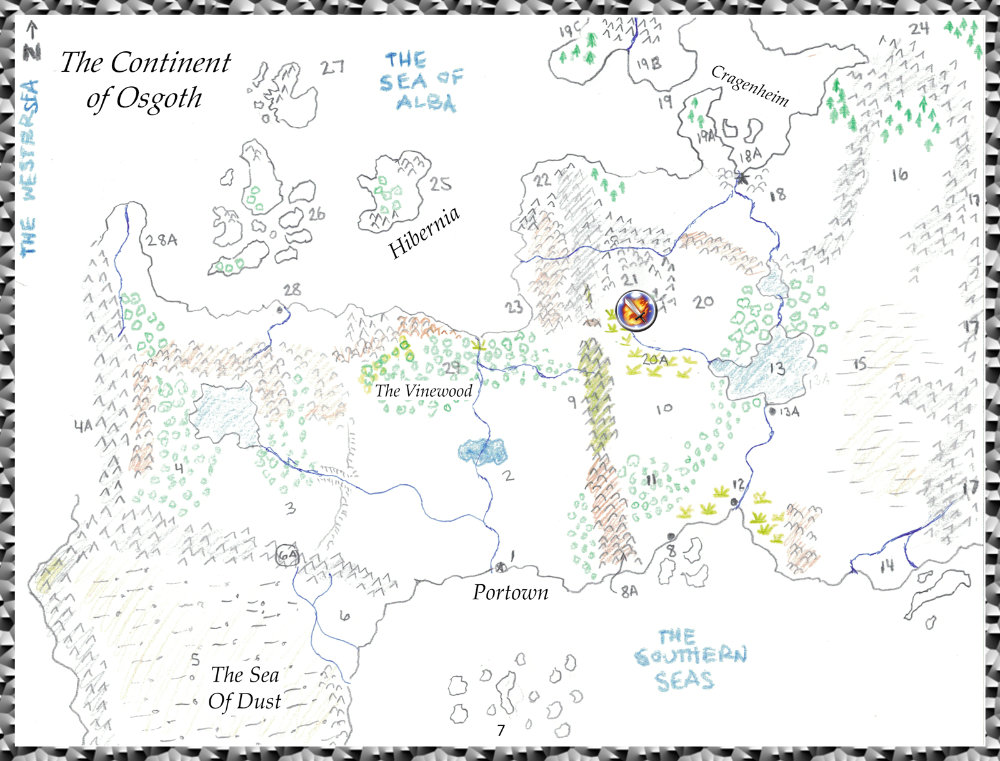
Osgoth Map Key#
Note to players: this is a map of the ‘known world’. The major regions are denoted by numbers, with descriptions of each set forth below. Each region is summarized in terms of political situations, rulers, gods, terrain and some description of note to adventurers. It is all ‘common knowledge’ a resident of Osgoth such as yourselves would know. Only major cities are noted (and described below) - no cities are named on the map, because an 8x12 piece of paper didn’t allow room. Major geographical features (large mountain ranges, hilled areas, forests (temperate and pine), large lakes, huge swamps, major deserts/steppes, significant islands and the largest rivers) are noted. This is not to say that ‘clear’ areas on the map do not include smaller forests, mountain/hill regions, lakes, ponds, smaller rivers, swamps or other terrain. Only the major areas are noted. Further, countless smaller keeps, cities, towns and villages exist throughout the continent, and none are noted on this map.
The party hails from the western half of the map - Menka from Stygios (#6), Cathal/Tim/Seamus from Hibernia (#25) - I would presume that Lycovane and Kyril hail from the Achean highlands/forests (#3), and the dwarves (Gonchar/Flint) come from Dwarven enclaves in the Hills of Krom in the north of the same region (also #3). But this can be discussed.
Note: The numbers on each section below refer to numbers on the map image, itself.
#1 Portown#
An enormous City-State, the Port of Karamekos, known colloquially as “Portown” to most inhabitants of the Realm. Portown is a major trading hub on the southern coast of the continent, Osgoth. It is a large, medieval trading city, governed by a Council of City Elders made up mostly of wealthy merchants (foremost of those, at present, being the Hadrigan family), with some prominent clerics and wizards. The party initially will have met in Portown.
Portown is on the southern border of the Duchy of Achea (#2), a large southern-European-style nation.
#2 Achea#
Achea is formally referred to as the Duchy of Achea, a large southern-European-style nation. In reality, its name derives from the southern Dukedom it once was, but the realm is now a formal group of allied free cities, lords, earls and dukes (all human) who unite as a council which meets annually in Portown, and who can be relied upon to participate in mutual trade and mutual defense. The influence of Achea and Portown stretches to the Vinewood (#29) to the North, the Port of Normands (#28) on the coast of the Sea of Alba in the northwest, and stops at the Gulden Draak Mountains in the east (#9) and the Iron League (#8 + 8A) in the southeast. In the west, it includes the Achean Plateau (#3) but stops at the Wyrmwood (#4). In the southeast, the Qeb Mountains (#6A) divide Achea from Stygios (#6) and the Sea of Dust (#5).
The borders of Achea, described above, contain wild lands that adventurers such as yourselves thrive on, but in general Achea is a civilized, stable land that has seen neither war nor humanoid incursions for many generations. While elvish enclaves exist in the forests of the borderlands, and dwarven kingdoms and gnomish communities are present in the hills and mountains of the borders, outside large cities like Portown, elves, dwarves, and gnomes are unusual and viewed with mistrust and superstition by many common humans of Achea. Halfling communities are more common and treated with less mistrust by Acheans.
The primary faith of Achea is the Greek Mythos. The common folk tend to be of mid-height, dark hair and medium skin tone. Most towns have a temple devoted to one god who is the primary deity of that community. Worshippers of the Norse Mythos are a large minority of tall, pale blonde and red-haired humans who traditionally hail from northern realms, primarily the northern kingdom of Cragenheim (#18 - 19). Another large, tolerated minority are worshippers of the Egyptian mythos who originate in the southwestern desert land of Stygios, generally a darker-skinned race of people. (#6). To the northwest are the barbarian island-realms of Hibernia (#25) and Alba (#27), pale, dark and red-haired folk who worship the Celtic gods, and are generally despised by Achean commoners, and typical Achean prejudices label them as drunken, potato-eating dullards who are incapable of little beyond fighting and reproducing like drunken rabbits. Acheans tend to tolerate the folk of the Kingdom of Many Isles (#26) more, as they tend to be more civilized, genteel and inclined to profitable trade.
The map of Achea in general does not include the various subdivisions of civilized regions, dukedoms and free cities - there are numerous towns, cities and villages, all of which tend to be well-maintained, devoted to industry/production of some kind (farming, cattle, timber, mining), rigidly governed and taxed by local noblemen, who in turn pay tribute to Portown. A large lake (Nyr Dystos) is a major geographic feature of central Achea, and supports several fishing villages. It is rumored to be of great depth “where huge things swim”, but that is unconfirmed. The Drino River flows from the lake south to Portown and into the Southern Seas, and the Asopos river flows north, into the Vinewood and the Sea of Alba. Another major river, the Acheron, flows from an even larger lake (Nyr Geneve), through the Achean Highlands (#3) and into the lowlands, where it meets with the Drino River.
#3 The Achean Plateau#
These highlands rise on the western half of Achea, seeming to rise suddenly up from the earth for hundreds of miles, stretching northward from the Qeb Mountains (#6A) to the Krom Hills in the north. This region is more lawless than the lowlands, but full of human villages and towns. A huge lake is a major feature of the Achean highlands - Nyr Geneve, also referred to as the ‘smoking lake’ based on the occasional strange bursts of steam which erupt from the lake’s cold waters, possibly created by whatever phenomenon causes mysterious, strange lights to glow from the deep of the lake on some nights. It is bordered on the east by the Susve Forest, a large stretch of thick woodlands populated by humans in the south, many of whom use it for timber which is then shipped down the Acheron River to the lowlands and Portown. The north of the forest is less settled - although abandoned by elves many years ago, to avoid encroaching humans, it is said that many humanoids - and bigger things best left alone - haunt its northern reaches and the Hills of Krom to the north of the lake. These hills also have dwarven enclaves. The folk of the Achean Highlands worship Olympus as do most Acheans, but the druidic faith is common in this region too.
#4 The Wyrmwood Forest#
To the west of the Achean Highlands (#3) (and on Nyr Geneve’s western shores) is the larger Wyrmwood, firmly under the rule of Oelvenfolk, who do not welcome strangers, and little certain knowledge of the forest, its rulers or what lies beneath the endless canopy of huge trees can be confirmed.
#4A The Molars of Dymathoin and the Wild Coast#
West of the Wyrmwood, is it believed that there are many miles of wooded hills - also jealously guarded by the Oelvenfolk, as hunters from the north who have strayed too far south have discovered, to their regret. Across the far west also stretches a mountain range known by some as ’the Molars of Dumathoin’, which stretches many thousands of miles from, in the North, the western edge of the Sea of Alba, where it meets the colder waters of the treacherous Westersea, to the Mountains of Qeb in the south, and beyond into the dry, parched wastes of the Sea of Dust. This mountain range is said to be the home of reclusive kingdoms of dwarves and gnomes who have no taste for contact with humankind, deadly dragons and giantkind, and volcanic eruptions, including one volcano of largest size (‘The breath of Moradin’) that is said to have erupted several generations back, and blocked the sun out of the sky for so long that crops in Achea would not grow for several seasons. It is said that if one were to somehow cross the Wyrmwood, and make it over the hills, and as far away as the Molars of Dumathoin, that a wild, unsettled coast lies on the shores of the Westersea, full of unspeakable monsters and peopled by wild sea-tribes worshipping strange, nameless gods. The map contains no details beyond the mountains, because none have gone there, mapped it and returned.
#5 The Sea of Dust#
At one time, many lifetimes ago, the empire of Stygios stretched across the south from the Southern Seas to the Westersea. The pharaohs ruled over a warm-climate paradise for centuries of prosperity and wealth. Some say the sea-currents changed and the land heated and dried, but legends also tell of arrogant pharaohs who placed themselves above Ra, Horus and Osirus, and knowledge-seekers - some, initially devoted to Thoth - who re-aligned their loyalties to different, older gods, and the forbidden secrets of those forgotten powers. So the gods of Stygios grew angry, and jealous, and blasted the land with sandstorms and Ra’s burning sun, and the rivers dried up, the rains stopped, and life was driven from the land. So what has remained for untold centuries is just that - a sandblasted, dry, endless stretch of featureless desert, with precious few oases within, beneath which is said to be the remains of those lost civilizations, and the buried gold, treasure, magic and secrets of the ancients - and some things which should stay buried.
Note: THE PARTY HAS TRAVELED IN A SMALL PORTION OF THE SEA OF DUST, BROUGHT THERE BY THE TRANSPORT-MIRROR OF GULDAR HEEL.
#6 Stygios#
What remains now of Stygios is only one northeastern corner of its former glory, a dry, yet livable land sandwiched between rivers (Eshara’s Cradles) which flow mightily from the Mountains of Qeb (#6A); and then struggle to stave off the encroaching desert before they lurch, diminished and sand-choked, into the southern sea. Out of the sands arise several cities of yore (Thebus, Zel-Amon, others) and numerous smaller villages, what remains of a once-mighty empire. Despite its faded glory, the people of Stygios, and the adherents of its faith (the Egyptian Mythos), still roam the nations of Osgoth and its influence is still widespread throughout Achea, and farther abroad.
Note: FATHER MENKA HAILS FROM STYGIOS AND WOULD KNOW FURTHER DETAIL OF THIS LAND.
#6A The Mountains of Qeb#
These peaks divide Achea (#2 - #3) from Stygios (#6) and the dry south, and are known to harbor many humanoids, giants and dragons.
#7 The Auld Isles#
South of Portown (#1), and east of Stygios (#6), lie the Auld Isles, spread across the southern seas below Osgoth. Legends say that in earlier times, the isles were home to Elves who, disdainful of ship-borne humankind, abandoned the isles to the far south, and reside - perhaps - in what are known as the ‘drifting isles’. Or perhaps not. But the Auld Isles are still a place of magic and natural, sylvan wonder - and more dangerous things, humanoids, and lethal wizardry, and strange, dour folk who worship something unnamable which resides beneath the waves. It said that at least one island is the stronghold of an ancient wizard of great power who disdains all but his research and looks unkindly upon those who set foot on his isle. The largest Isle, Belfaras Island, has a fairly large city-state, Reyhu, and a modicum of civilization, but others, such as Tol-Morwen or Tol-Sirion (where in years past another great wizard, Yrammag, was said to have been on the precipice of great power before being defeated by a band of adventurers and freebooters), are said to be perilous places, peopled by dangerous folk - and good folk as well. While the sea-merchants of Portown will visit certain isles, they do so only in large, well-armed vessels, for pirates are not unknown in the Isles, including the dread Lemulus, and his Brotherhood of the Iron Fist.
#8 The Iron League#
The coastal city of Po is the home of the Iron league - sea-lords from the Isles of Iron, whose naval power and mining interest on their islands spread to the mainland, where they soon conquered the Ulek Hills (#8A), driving out its dwarven lords and usurping the valuable iron ore common to those hills. There, the League now works those mines and makes itself wealthy with iron ore and an industry of weapon-making which is of the highest quality and which fuels trade with other powers. Now, the former sea-lords of the Iron League have mainland possessions which amount to more territory than their island strongholds. They hold the Ulek Hills (#8A) firmly, and their deadly patrols of mounted knights forestall incursions from dwarves from the north, elves from the forests of Aentwood (#11) to the north, Trolls from the salt-fens to the east, and any challenge from Achea (#2) in the west. While traders and other outsiders are not unwelcome in Po, any challenge to the supremacy of the Iron League and its holdings are dealt with swiftly and brutally.
#9 The Gulden Draak Moutains#
While the Dwarves of the Hammerhold were driven north and out of the Ulek Hills (#8A) by the encroaching Iron League (#8), the League made no inroads to the true treasures of Clan Hammerhold - the extensive silver and gold mines beneath this range of mountains. The borders of this mountain-realm are ringed by traps and large field-weapons manned by hordes of dwarven defenders, behind which are extensive mines which tunnel beneath these peaks and provide wealth with which this Clan built huge underground palaces and towns. These dwarves - while militant - are friendly traders outside their jealously-guarded borders and build their wealth by trade with both Portown and Cragenheim, and their associate empires - while keeping their shields, axes and hammers stoutly pointed towards the Iron League (#8) and the Crimson Brotherhood (#10).
#10 The Crimson Brotherhood#
It is said that in this remote region - at one time a loosely-aligned collective of tribal villages and towns which traded regularly with the Free Cities of the north (#20) and Lakemoor (#13A) to the west, and the Lake-Folk, was long ago brought under the thrall of an order of monastic religious militarists. The red-clad order is purported to espouse the teachings of an ancient faith, details of which are unknown, but which is said to raise the banner of a crimson, fiery amoeba surrounded by tentacles. This group now controls the whole of the land from the Troll Heaths (#20A) swamplands of the north and the borders of the region of free cities, to the Aentwood (#11) in the south (and which is said to control portions of that forest in the east, to the chagrin of the Aentwood’s elven lords), and borders upon the foothills at the base of the Dwarven kingdoms which hold the Gulden Draak Mountains (#9). Rumors - and these are only rumors, based upon the few and daring who have crept into the borderlands of the Brotherhood, or those traders from Po (#8) or Saltfen (#12) who trade with them - contend that the Brotherhood is a tripartite of thieves, assassins and monks, the latter being the ruling class of the region. The high temple and monastery of the Crimson Brotherhood is supposedly a fortress and walled town unto itself, said to be guarded by humanoid legions which are being prepared for future conquest, and monsters trained (or summoned) to serve the Brotherhood. The truth of this is unknown, but what is known is that agents of the Brotherhood operate throughout Osgoth, sometimes in their trademark crimson robes, but more often is disguise and, some allege, highly-placed in the courts and councils of Cragenheim (#18A) and Portown (#1).
#11 The Aentwood#
This vast, ancient forest stretches from the Ulek Hills (#8A) in the west, to the borders of the Salt Fens (#12) in the southeast, north to the shores of Nyrdaep (#13), and nearly to the City of Lakemoor (#13A) in the Northwest. At one time these woodlands were said to have stretched much farter north and east, but The Crimson Brotherhood has fueled its economy with trade of rare woods from the forest, and its size has lessened.
It is still vast and is said to be the home of a large, savage and reclusive tribe of Grugach (Wild Elves), who guard its borders jealously, and have long been in constant battle with the encroaching Brotherhood (#10) - although the Brothers of the Crimson Sign have only made headway in the northeast borders of the wood. The Grugach still hold inviolate the southern regions of the Aentwood, and the forest is said to be also occupied by huge, talking trees, carnivorous plants, reclusive giants and other occupants who act to bar incursions from outsiders.
#12 The Salt Fens#
The Tigriso River flows south from the huge Lake Nyrdaep (#13), and empties into the southern seas, at its mouth creating an enormous, salty swamp which borders the eastern lands of the Iron League, and the western borders of the ancient kingdom of Sumria (#14). At the mouth of the river/lagoon also sits the Free City of Saltfen - also referred to as ‘Night City’ - which is built upon a foundation of always-crumbling wooden piles driven deep into the marshy ground of the river’s mouth. Saltfen is a bustling hub for trade between the north, Achea (#2), the Iron League (#8), and the Sumrians (#14) to the west, as well as the distant eastern folk of Kara-Tur, who reside in lands far across seas to the east. It is also a dangerous, lawless place where the slave-trade flourishes, men (and women) disappear, where humanoids walk amongst men, dwarves and elves in a tense truce, and which is ruled over by an immensely powerful Thieves/Assassin Guild, the Black Orchid, named after a flower which grows only in the fens, and is said to cause magical, sometimes deadly, hallucinations when consumed. The tentacle-like influence of this Guild reaches across the whole of Osgoth. There are no secrets in the salt-fens, or indeed across Osgoth, which the Black Orchid are not privy to, and the free and ungoverned trade that happens in the Free City always includes a share for the Orchid.
#13 The Nyrdaep, Lakemoor and the Lakemen#
The Nyrdaep is Osgoth’s largest lake, which stretches for many hundreds of miles, bordering the lands of the Free Cities (#20) and the Forest of Rel-Valnor in the northwest, the Steppes of the Roos (#15) in the east, the Great Swamp (#20A), the lands of the Crimson Brotherhood (#10) and portions of the Aentwood (#11) in the west and the Free City of Lakemoor (#13A), which sits upon the southern shore of the lake. The shallow borders of portions of the Nyrdaep are occupied by the Lakemen, fisherfolk who are said to build floating towns which attach to the shores of the lake, and which are built so for defense against hostile neighbors such as the Brotherhood (#10), the wild nomadic tribes which roam the Steppes of Roos to the east (#15) and, more recently, large raiding parties of orcs and other humanoids which have taken to sweeping down from the northeast on raids for gold, slaves and human flesh.
To the north of the lake is the Forest of Rel-Valnor - human villages and towns are found through out the western portion, nearer the free cities, and over the River Mirk in the wilder western forces a tribe of unusually tall elves are said to hold sway, and often do battle with the aforesaid raiding orc-armies, who seek wood to assist in their war-plans and to burn as fuel for their weaponmaking forges. Farther north is the Nyr-Murk, a huge lake which, while much smaller than the Nyrdaep, is still vast.
The center of the Nyrdaep is said to be so deep as to be almost bottomless, say some. In its depths monsters of vast size are said to swim, and sometimes surface to feast upon lake-men, and legends tell of societies of mysterious tentacled things in its deepest portions, and underwater caves which lead to the underdark, and huge cities beneath the earth. But these are rumors, the kinds of tales told to visitors in the taverns of Lakemoor.
#13A Lakemoor#
A large, free city peopled by folk of the druidic faith, and an army of rangers who patrol the shores of the lake and river to the south, and punish sorely any orcs or Roos-nomads who are so foolish as raid from the north and west. Lakemoor has been, as yet, untroubled by the Crimson Brotherhood (#10), likely because the Grugach of the Aentwood (#11) hold them at bay.
#14 Sumria#
It is said that the ancient land of Sumria was at its greatest power in days of yore when Stygios (#6) in the distant west was it its apex, and legends say that its kings once rode dragons into battle and were served by powerful wizards and priests who caused Sumria’s enemies to quake with fear. These legends, if true, tell of a civilization long-past. The Sumrians now occupy a warm, dry, barren mainland at the southeastern corner of Osgoth, in crumbling, ancient cities huddled around rivers which flow from the vast eastern mountain range. Its people have little wealth or resources which would invite invasion or much trade, as its once-vast forests were long ago felled, and its once-rich mineral wealth all mined. The Sumrians worship their own ancient gods and are said to be ruled - if ruled at all - by a reclusive, sickly albino king who dwells on a large, overgrown island off the coast.
#15 The Steppes of Roos#
The vast eastern grasslands of Roos are said to be occupied by enormous herds of wild, dangerous cattle and horses, the former of which are hunted by mounted tribes of nomads who roam these untracked wastes, as well as Rocs who are said to fly from the eastern peaks to feed upon the vast herds of wild herbivores. The nomads of Roos are barbaric, reclusive and savage, sweeping out of the steppes to occasionally raid the Lakemen on Nyrdaep (#13), the folk of the salt-fens (#12), the slim pickings of the Sumerian lands (#14), and it is said that adventurous parties of these raiders have even been known to raid the richer lands of Cragenheim (#18) to the northwest and the Iron League (#8) to the southwest for treasure and female captives, although such raids are rare, and usually not worth the danger inherent in make incursions into such well-guarded lands. The nomads of Roos also historically do battle with the northern orcs of the Bone Tusk (#16), although some say there could be an alliance between the Bone Tusk and some of the nomad tribes, which could be bad news for bordering lands, as these barbarians fight savagely, and give no quarter. But this is unconfirmed.
Tales are also told of crumbling ruins of ancient cities in the deepest wastes of the steppes which hold great riches and lethal dangers.
#16 The Bone Tusk#
This valley, surrounded by mountains and said to be occupied by vast pine forests and cold marshes, is home to the Bone Tusk, an enormous alliance of humanoids steeped in evil and wickedness. Orcs are the primary occupants of the Valley of the Bone Tusk, which is named after the largest, dominant tribe of these creatures, who are said to be of huge size and physical power. Tales tell that the Bone Tusk are led by Yurtrus the White Handed, a giant-sized orc of terrifying power who is said to be able to cause disease with a wave of his hand, and whose legions, when he rides forth, ride under a banner of a White Hand. But this is rumor. Also allied with this orcish legion are said to be ogres, trolls, giants, hobgoblins and many evil tribesmen, clerics, thieves, assassins, fighters and wizards who have gathered under the grim banner of the Bone Tusk and the White Hand.
What is known is that the Lord Jarl of Cragenheim (#18) takes the growing power of the Bone Tusk very seriously, and the eastern reaches of the Empire of the Great Jarl are heavily fortified, and in a constant state of skirmishing with orcish raiders. Those in the know say that it is not a case of if, but when a war is coming, and wonder whether it will begin with orcish legions sweeping out from the mountains of the east, or whether Cragenheim will marshal a horde of Northmen to break the growing power of the Bone Tusk. Or whether the Bone Tusk will march farther south.
#17 The Spine of the World#
Also known as Jormungandr’s Spine, The Teats of Luthic and The Huts of Nin-Hursag.
This vast mountain range goes by a variety of names particular to the societies whose lands border it, but whatever name these peaks are called by, all agree that these mountains are widely regarded as endless, deadly and unable to be crossed by land. Of course, they are not endless - it is known that the distant land of Kara-Tur is on the far side - but at very least the range stretches many thousands of miles from the eastern edge of Osgoth’s civilized lands. What is within this trackless territory - other than high peaks, earthquakes, impassable terrain and volcanoes - is not known, but there is endless speculation and bits of knowledge gleaned from what comes out of the mountains, and tales told by the few explorers and fur-trappers who have ventured within, much of it little more than legend. To be sure, orcs, ogres, various goblinfolk and giants thrive there, driven to the mountains by the swords, bows and axes of men, dwarves and elves, and the current power to the Bone Tusk surely derives its numbers from the distant mountain retreats of orc tribes. But tales also tell of dragons of largest size, rocs with wingspans that could cast a shadow over a castle, stones and rocks which speak, and tribes of dwarvenfolk who toil in mines rich with ore, and build vast gold-plated underground kingdoms, far from the greedy eyes of men.
#18 The Northern Lands of Cragenheim#
In days of yore, the lands of the Northmen were loosely associated tribes ruled by local jarls, led by sustenance farming, hunting and fishing the cold but fish-filled northern seas, supplemented by raiding of the (surrounding) lands and seas. Generations ago, the militaristic northern tribes united under a single Great Jarl, centered in the City of Cragenheim, and set about conquering the surrounding lands, now known as the holy empire of Cragenheim. The folk here chiefly worship deities of Asgard. The land of Cragenheim itself is now used for vast farms which grow wheat and other foods in the warmer months, and with enormous herds of sheep and goats in the highlands throughout the realm, all governed by local jarls who operate under the watchful eye of Cragenheim. The empire stretches to the mountains of the west where the Bone Tusk now looms (#16), to the associated northern fjords and lands of Daneheim (#19A), Svenheim (#19B) and Nordheim (#19C), all formerly independent realms of the Northmen who are now beholden to the Viking-king in Cragenheim, and whose dragon-ships sail in his name. In addition, Cragenheim has extended its holds over the Free Cities of the North (#20), now free only in name, all of whom pay tribute to Cragenheim, and who are now protectorates of the Great Jarl - but essentially operate otherwise as free cities, as they always have. Cragenheim’s empires stretch west to the ‘borderlands’ (#21), although this is largely in name only - the scattered towns, forts, villages and keeps of this wild land are sworn to Cragenheim, but are remote and hard to reach, surrounded by high peaks and only rarely visited by the Great Jarl’s agents, and then only to collect the meager taxes that these far-flung holdings produce. Further, the agents of Achea and Portown hold some sway in the borderlands, and loyalty to Cragenheim is ‘soft’, just as Portown likes it. More closely held by Cragenheim is Fjalarheim (#22), straight west on the northern coast from Cragenheim, whose ports allow the Great Jarl to exert control over the shipping lanes of the northern seas, and take advantage of the iron, tin and other ores mined by the loyal dwarves of Fjalargeim. But the Great Jarl’s ambitions farther west and south must wait, for the Bone Tusk’s growing legions are a threat more pressing and urgent.
#18A The City of Cragenheim#
This city, built into the cliffs and the vast natural harbor overlooking the Odinfjord, is the capital city of the northern realms, a great melting pot of the north, the isles to the west, the varied folk of the south, and even the men of distant Portown, all of whom visit and trade here. The Great Jarl - the current one having earned his crown by challenging the former Great Jarl to personal combat, as is the way of Jarldoms in the North, rules the north with a benevolent but iron fist. The City is guarded by vast fleets of dragonships and enormous keeps on the twin ‘wolf-islands’ of Freke-heim and Gere-heim, but the Great Jarl’s attentions have shifted from prosperity to the coming battle with the Bone Tusk.
#19 The Fjordlands#
The other three realms of the Northmen, Daneheim (#19A), Svenheim (#19B) and Nordheim (#19C) are all loyal to Cragenheim and devote their swords, axes and longships to the Great Jarl. These are cold lands peopled by hard folk, who scrape what they can from the rocky soil and their sheep and cattle, supplemented by raiding of Hibernia (#25) and Alba (#27). Daneheim is part of the mainland, and is closer to the folk of Cragenheim, and shares the same dialect of the northern tongue. The twin realms of Nordheim and Svenheim, while they share the same gods, speak different dialects and are separated by the towering peaks known as the Teeth of Fenris, a mountain range which stretches north for many, many leagues, into the frozen lands haunted by the dread Ithaqua, the ice-walker - although these peaks are also reputed to be the home of the legendary and horrid red dragon Saladrex, a horror of largest size who is said to reside in a complex beneath a ruined city, and whose lair is guarded by lethal servants and traps, and where he sleeps on a huge bed of gold, gems and treasures he has stolen from many victims over the course of many centuries.
#20 The Free Cities of the North#
This large geographic area - largely open, rolling plains and hills, full of fertile lands, well-watered with small tributaries of larger rivers - is bordered by the Uller Highlands (populated by tribes loyal to Cragenheim), and Cragenheim proper to the north of that (#18) and the Kjolen Mountains (“The Keel”) which divide the Free Cities from the borderlands to the west (#21). To the east is the broad forest of Rel-Valnor - itself sprinkled with human communities in its western reaches which identify as part of the Free Cities - and the lakelands (#13), and to the south is the vast Troll Heaths (#20A), created by runoff from the Laketide River, which flows forth from the Nyrdaep and drains into the heaths, considered to be the southern border of the region.
The region is largely civilized, worships mainly Asgard but also a large minority of deities of Olympus and the druidic faith (and other faiths). The area is populated by a series of small baronies and city-states (none of which are detailed on the map, as there are many), led by minor nobles, which historically would provide mutual support in times of need. In recent times, the Free Cities stand beholden to Cragenheim and are part of the empire of the Great Jarl.
#20A The Troll Heaths#
This vast swampland is the southern border of the region of Free Cities (#20) and, as its name suggests, is known for the particularly large, horrid and animal-like trolls which populate its murky, dark depths and feed upon the teeming wildlife within, shaded by large, bloated trees which lurch forth from its fetid mud, creating a wide, dangerous barrier between the north and south of the continent - and thankfully, in recent times, has prevented any northward expansion by the Scarlet Brotherhood (#10). Despite this, a trade-route has been hacked out of the northwestern reaches of the heaths, and is used by well-guarded merchant caravans which travel from Achea through the Vinewood (#29) and north of the Gulden Draak mountains (#9), through a wide natural pass which must cross the swamps into the lucrative trade-regions of the free cities - meaning that fighters, rangers and fighting men never want for work in this region, for the trolls do not seem to tire of picking off meals from such caravans when they can.
#21 The Borderlands#
This area is the southwestern border of the Great Jarl’s holy empire. The scattered communities therein are made up of hardy folk who swear fealty to the great jarl in Cragenheim, but would just as soon swear fealty to Portown, or to Odin himself. Indeed, Achea has had great influence here at times - most recently, the worshippers of Bacchus from the Vinewood (#29) - although the region was for a long, dark period under the thrall of Heimfell, the dread two-crowned king, who united the numerous humanoids and other evil creatures of the area and ruled the borderlands with an iron fist, threatening the free cities, Gulden Draak and the southern borders of Cragenheim itself, until combined forces of men, dwarves and elves defeated the Two-Crowned despot and his grim host, and drove him deep beneath the earth, where it is said he has waited, plotting to return. Or perhaps he lies in a permanent undeath beneath the ground. Or perhaps he is truly dead. In any event, following Heimfell’s defeat, the region has since sworn fealty to Cragenheim, but remains lawless and the human communities there largely operate as autonomous baronies and free towns/cities which are part of the empire in name only.
Note: THE PARTY IS IN THIS AREA NOW, WHICH INCLUDES THE WESTKEEP, MARKHEIM, THE FOULED TEMPLE OF DIONYSUS, THE HALL OF SEVEN PILLARS, COLD DRAKE CANYON, SILVERSTONE HALL, AND OF COURSE THE TOMB OF THE TWICE-CROWNED KING
#22 Fjalarheim#
This northwestern corner of the Great Jarl’s empire contains the rough-hewn port and trading city of Winterkeep, largely the home of a large clan of dwarves loyal to Cragenheim, with mixed communities of Northmen, Hibernians and traders from the Kingdom of Many Isles. This port city is the only usable natural harbor on the Coast of Serpent’s Teeth, which coast is (south of Fjalarheim) rendered largely useless for maritime trade by the rocky, deadly coast, mudflats and dangerous tides to the south. The dwarves mine the surrounding hills and northern reaches of the rocky, largely impassable Fjallen Mountains (“the Fells”), which provide iron and other ores for profitable trade, and are a vital mining (and trading) hub for the great Jarl, so his longships are always a major presence in the port’s docks.
#23 The Coast of Serpent’s Teeth#
This coast winds up from the Vinewood (#29) in the south and is rendered unnavigable in the south by the ‘Serpent’s Teeth’ a treacherous series of sharp rocks which lurk just beneath the waterline, or loom above the waterline as sharp, jagged barriers to any boat travel except by the most foolhardy or skillful sailors. Further, the region’s only major river, the White River, flows from the mountains to the east with such fury that it is unnavigable to travel, isolating the region further. Farther north the coastline is characterized by mudflats which prevent any ports from being built, and the only large community is Leilon, a mining community which is a firm ally of Winterkeep (and by extension, Cragenheim, although they are too remote to pay tribute), who dig rich lodes of copper, nickel and silver from deep mines in the mountains to the east, and eke out trade with Winterkeep and well-armed caravans which travel up the coast from the south, although trading routes through the wild Vinewood (#29) were closed by the fay-folk years ago, rendering the journey to Leilon lengthy and less palatable. The remainder of the region is lightly settled, and subject to danger from the orcs, bugbears, trolls, ogres and giants who haunt the region from their strongholds in the hilly region, and The Fells, which mountain range represents a largely-impassable barrier between the coast and the Borderlands (#21) and Free Cities (#20) to the east.
Note: THE PARTY HAS BEEN IN THIS REGION, AS THE TEMPLE OF DIANCECHT IS HERE.
#24 The Faen-Land#
This distant, icy northeastern realm is proximate to Cragenheim, but the folk here, who worship their own gods and keep their own council, offer little incentive to conquest, as they fight fiercely and have a long history of fending off incursions by northmen, humanoids and more grim assailants from further north. They are known to be largely nomadic, driving huge herds of reindeer and riding great, fur-covered horses. There are said to be large communities across the land, and these people are reputedly ruled by Vainamoinen, a fighter of great renown, although this individual may be more of a war-leader than political head of state.
#25 Hibernia#
This large northern island, also know as Eire and ’the Emerald Isle’, is a temperate land, warmed by local sea-currents despite its northerly location, as opposed to the fjordlands of Cragenheim, which are chilled by icy currents from further north. The folk of this land worship Celtic gods and tend to be organized into various regional clans led by chieftains, who sometimes unite under a high king, particularly when need arises pertaining to invasions of the island. The Hibernians engage in farming (potatoes being a particularly popular crop), and cattle and sheep-raising, and hunt the plentiful boars, deer and bear which roam the island’s forests and hills. The island is also home to populations of giants and ogres in the highlands, and the fey-folk in less-populated portions of the island. Hibernians are a friendly folk, prone to drinking ale, but dislike those from the Kingdom of Many Isles, whom they view as untrustworthy and arrogant. The island has been a frequent subject of invasions from the Kingdom of Many Isles and the Northmen to the northeast, and at present there are settlements, largely peopled by warriors and pirates funded by ambitious Nordheim (#19C) jarls, on the northern coasts of Hibernia.
Note: CATHAL, TIM AND SEAMUS ALL HAIL FROM THIS LAND, AND CAN BE PRESUMED TO HAVE MORE KNOWLEDGE PARTICULAR TO THE ISLAND.
#26 The Kingdom of Many Isles#
This large group of islands (the largest of which are depicted on the map) were historically ruled by a series of noble lords who presided over a particular island or group thereof, but in recent generations one Lord, Alfred Pendragon, united the island kingdoms under one crown, and his son Uther now sits on the throne of the isles. The Kingdom counts Alba (#27) to the north as part of its holdings, but in truth this is limited to the fealty of the Caledonian lords who occupy the southern portions of Alba, not the Pictish Clans of the northern highlands.
The Kingdom is a seafaring powerhouse, with great naval power, and sustains itself not only with farming, cattle and sheep much as the other folk of the Alba Sea do, but also fill their ruling lords’ coffers by fishing and trading throughout the northern seas. Most land is held by nobles.
The Kingdom has an official state religion, the Church of St. Cuthbert, named after a warlike, authoritarian saint who preached the supremacy of the “one and true god”. This faith is overseen by a strict, lawful church of stern clerics, and who preach a credo of “faith in church and king”, fealty to the noble rulers, and punish the worship of other gods (although it is said that the worship of the Celtic gods and Asgard remains in more remote regions of the isles, far from the prying eyes of nobles and priests). By contrast, the common folk of the Kingdom are well-known as friendly, hardworking, practical people who, despite the church and nobles, live well, untroubled by humanoids or giants, who have largely been driven from the isles, but for a few trolls who are said to haunt the more far-flung corners of the isles.
The folk of the Kingdom have settled the lands (#28A) west of the Port of Normand. (#28). Although the Port is a City allied to Achea and Portown, the wilder coastlands to the west are sparsely settled by adventurous Kingdomfolk, with varying (and in some cases, no) loyalty to their king and lords, but largely self-sufficient.
#27 Alba#
This rocky island was for a long time an independent island. However, of late, Alba, and the Lords of Caledonia in the island’s south, are loyal to and considered part of the Kingdom of Many Isles (#26). These lords occupy the cities and towns of the south, while the northern highlands and western isles are ruled by kilt-clad Pictish clans who raise huge herds of sheep and cattle and answer to only themselves. Some of the many western islands are ruled by various jarls - essentially, pirates from Nordheim (#19C) who fancy themselves as lords of the northwestern isles. There is a large city in the southwest, Glas Comh, which is said to house an island in a lake that sits in the center of the City. This island is known as the ‘Necropolis’ and is said to be haunted by the undead. The largest city on the eastern coast, Lothian, is a walled hill-fortress and the center of loyalty to the Kingdom.
#28 The Port of Normand#
This large, bustling port is the northwestern point of Achean influence, and the City is loyal to Achea and the merchant-lords of Portown. The city is governed by a council of guildmasters, but the preeminent power in Normand is Cullen MacLoed, who has been the figurehead of Normand for many decades. He is reputed to be a former adventurer, pirate, possibly of partial elven blood (for he appears very young, yet is at least 80 years old, perhaps older), possibly of noble background, and reputed to be a mighty warrior, bard and, some say, a spellcaster. He also has family connections in the Kingdom of Many Isles, Hibernia and Alba, and is married to one Lady Wyatt, a noblewoman of Achean birth. He uses this long experience and many connections to foster an atmosphere in the port city which welcomes not only Acheans, but Hibernians, Kingdom islanders, men of Alba and even ships from Cragenheim, despite the empire’s enmity with Portown. As such, the Port thrives, with traders from the northern seas calling at its docks, and merchant caravans traveling forth from Normand across trading routes which stretch to all regions of Achea, all the way to Portown, as well as across the Vinewood and into the Free Cities, Gulden Draak, the Borderlands, and even Leilon and Cragenheim itself.
#28A The Manuxet Coast#
Stretching west from Normand is the Manuxet Coast, named for its frequent soaking, cold rain which seems to fall for most of the year. This is sparsely settled, closest to Normand, mostly by the descendants of Kingdom islanders with no love for the nobles and their St. Cuthbert, and who worship the Celtic gods mostly, but it is different as the coast extends northward to the Miskatonic Peninsula, which juts into the northern ocean and is known as a windy, rainy, rocky land. Here are many towns and villages, some huddled up and down the Manuxet River or (mostly) situated on the coast and peopled by dour, reclusive descendants of Kingdom islanders who have bred with folk said to come from outer, unmapped islands far out in the reaches of the sea to the northeast. These people are rumored to worship older gods, possibly derived from the savage tribes which occupy the mountains and forests to the south of the Peninsula, or perhaps from the sea-folk who emigrated here from their far-off islands. It is reputed to be a grim, unwelcoming place, but visitors have whispered of strange rituals, odd inhabitants, disturbing howls and cries, and maddening, piping music which echoes across the lands of this isolated place. As such, even traders from Normand rarely venture there, although the odd folk who reside in that place sometimes come to the port and trade with ancient-looking coins with strange images stamped onto them - but gold is gold, as they say in Normand.
#29 The Vinewood#
This huge, dense forest stretches across the north of Achea. In its central and eastern portions, it is known for grapes of many varieties, which grow in proliferation, and it is known to produce the world’s finest wines. The folk here are known as adherents of Dionysus, and indeed the main temple of the god is said to lie deep in the forest, where wine is produced in great quantity and is said to be of the highest quality, and where the faith’s adherents often flock to participate in (and not always survive) the Bacchanalia. Apart from these debaucheries and the Dionysians, the forest is also home to numerous communities of humans scattered throughout, a remote community of reclusive elves, some forest-halflings on its western edges, druidic enclaves, dangerous creatures of all kinds, and large herds of centaurs who guard portions of the forest with jealousy. A major trade-road from Normand to the eastern lands runs through this forest, and rare is the caravan which is not obligated to pay tribute to the Centaurs, and very occasionally a caravan has been known to disappear altogether, but not so much as to halt this thriving trade-route.
Note: THE PARTY, OBVIOUSLY, STARTED THE ADVENTURE HERE, AND KNOWS SOME OF THIS FOREST’S PLACES.